Underland Palace
Bride of AlvarUnderland Palace is the royal seat in which Lucy’s private life is converted into public destiny. It receives her as a promised Earth bride, stages her wedding to Alvar, exposes the king’s hidden condition, shelters her through captivity and recovery, and ultimately becomes a place where she speaks as Queen Lucy rather than as the child whose future was arranged before birth. Its beauty and ceremony never erase its coercive politics; instead, the palace makes the connection between marriage, healing, inheritance, and interworld peace physically visible.
Arrival and Material Splendor
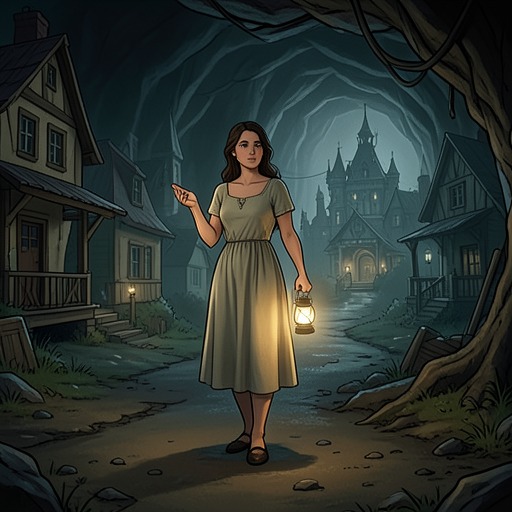
Underland Palace first appears as a courtly environment sharply opposed to Lucy’s ordinary life on Earth. After she reaches Underland City, whose white stone buildings and silent streets are governed by curfew, she enters the palace courtyard. A lit fountain occupies its center, its moving water illuminated around brilliantly colored fish, while tropical greenery and angelic statues create a mystical, cultivated enclosure. The setting presents royal power through controlled beauty: nature is not wild but arranged, illuminated, and placed within a ceremonial architecture. Fletch guides Lucy through this space while a pale human attendant silently takes Titan from her. The removal of her familiar companion accompanies her entry into court life. Fletch then tells her that she will need new clothes and will soon be dressed as a proper Underland beauty, making the palace a site of transformation as well as reception. Lucy is not merely being housed; she is being refashioned for a role defined by Underland custom. Her chambers intensify that impression. Fletch opens a door and formally welcomes her as Miss Lucy, while the brief response to the room’s apparent magnificence registers her astonishment. The palace therefore functions from the beginning as both refuge and instrument: it offers luxury, protection, and status, but it also surrounds Lucy with institutions capable of redefining her body, clothing, name, and obligations.
Marriage, Law, and the Royal Household
The palace is the setting in which a private promise made before Lucy’s birth becomes a political marriage. Hannah Delaney explains that Alvar saved Lucy when she was dying in the womb after Hannah promised that her daughter would become his. The written agreement, signed by Hannah and Alvar, is sworn to Elias, the God of Light, and dated October 10, 1993, on Earth and the twenty-third day of Havath, 2918, on Axus. It betroths the female child to King Alvar as his future wife and queen, securing a peace treaty between Earth and the realms of Axus. The agreement gives the palace a legal and diplomatic meaning beyond royal residence. It promises that, once Hannah and her daughter are brought to Underland, their material and personal needs will be provided for, along with the protection of the Underland Guard and instruction from the Institute of Underland in the customs of its people. The palace is consequently imagined as the endpoint of a treaty’s provisions: a protected household, a school of cultural assimilation, and the center of a monarchy whose stability depends upon Lucy’s incorporation into it. That incorporation is staged publicly at the wedding. Lucy’s mother holds the train of her wedding dress while Fletch leads her down stairs into a chapel-like space. Hundreds of people wait in murmuring expectation, their collective voices producing a low rumble in the air. The palace transforms an arrangement made between adults into a spectacle witnessed by the population. Lucy’s body becomes the visible link between Earth and Underland, while the crowd’s presence turns her uncertainty into a matter of state. Yet the palace does not make the marriage emotionally simple. Before the wedding, Lucy recognizes that Mike is her promise of stability and a fresh start, but that their relationship is based on solid friendship rather than passionate love. She realizes that she wants to remain his friend rather than become his lover, and that this means she should not marry him. Inside the palace, the alternative marriage initially appears imposed by treaty and maternal debt, but Lucy’s resistance to Mike clarifies that the issue is not simply choosing security over danger. The palace becomes the arena in which an inherited obligation is gradually tested against Lucy’s own desire.
Hidden Truths and the King’s Exposure
The palace’s ceremonial surface conceals the history that makes Alvar’s kingship precarious. Alvar tells Lucy that Cursed blood was infused into her veins while she was still in Hannah’s womb because it was the only way to save her life. In Lucy, the blood produces rapid healing rather than the monstrous transformation associated with Alvar. He further explains that she is, as far as he knows, the only person on Earth who can carry his children without dying, making her both a political bride and a biological exception crucial to his future line. This revelation changes the meaning of the palace household. Lucy was not selected only because of a signed treaty; she was also the compatible person Alvar believed could bear his heirs. The royal home is thus tied to reproductive politics as tightly as it is to diplomacy. Lucy’s body carries the consequences of a bargain made before her birth, while the palace is the institution that would benefit from her marriage, fertility, and public legitimacy. The deepest truth is revealed in the palace’s circle of truth. Leeza and Yal open the doors to a circular room with brilliant white marble floors and three concentric rings of water, each about three inches thick. Sola stands in the central ring with her sapphire blue and white wings raised, and mirrors surround the chamber. These mirrors do not return ordinary reflections: Lucy appears shrouded in fog-like mist, while Alvar appears dark with blood, especially around his mouth and hands, wearing a black collar set with red gems and a wraith-like chain that seems painfully tight around him. The room converts hidden identity into visible evidence. The palace’s whiteness, ceremony, and royal symbols are countered by the blood-dark image of the king. What had looked like a stable monarchy is exposed as a facade maintained around a curse. The palace is therefore not simply the place where Alvar rules; it is the place where the contradiction between kingly appearance and dangerous reality can no longer remain private. Alvar eventually addresses the people of Underland from the palace chapel. He announces that Saul, described as a malevolent tyrant, is returning and will again try to oppress them. He admits that he cannot save them from the monster Saul controls or protect their families as he promised, then begins to tell them that he is undeserving of being their king because his public identity is a facade. The palace becomes a political stage for confession: authority is not preserved through concealment but placed at risk through disclosure.
Danger, Captivity, and Recovery
The palace also records the physical vulnerability hidden beneath royal protection. After Saul attacks Lucy and she loses consciousness, she wakes in Alvar’s room. The familiar room, previously associated with beautiful memories shared with Alvar, is now dark, with closed windows and low lights. Her wrists and ankles are bound together, leaving her unable to move. The contrast turns a place of intimacy into a prisonlike chamber and makes the palace’s emotional geography as unstable as its political order. Lucy’s response shows that the palace cannot reduce her to a protected object. Although her situation is bleak, she refuses to stop fighting until she is dead. The room becomes the setting for continued resistance rather than passive rescue, preserving the distinction between royal shelter and actual freedom. Its walls can hold memories of love, but they can also contain violence, confinement, and the aftermath of forces larger than Lucy’s domestic hopes. Later, Alvar recognizes that Lucy’s injuries are not the whole of what has happened to her. He says that Saul, Lord Vessin, and everything she has experienced since arriving have shaken her, and he offers Earth as a possible retreat. The palace thus becomes a place from which departure is still imaginable. Lucy’s decision not to leave gives that possibility its emotional and political answer: she says she cannot return to Earth because Alvar is not there, because she loves him, because she loves Axus and Underland and wants to see them prosper, and because she wants to have his babies. Her declaration changes the palace from an imposed destination into a chosen home, though not an uncomplicated one. Lucy’s attachment is directed simultaneously toward Alvar, the country, and the future of the realm. The royal residence no longer signifies only the treaty that claimed her; it becomes the center of a life she actively accepts and a political future she wants to help build.
Royal Future and Narrative Significance
By the later stages of the story, Lucy identifies herself as Queen Lucy of Underland, no longer the embarrassed young woman who allowed others to define her through her upbringing or her mother’s instability. She understands herself as a woman who wants to live on her own terms, and the idea of being Alvar’s wife begins to appeal to her. In the palace, that self-definition is symbolized through direct physical and verbal intimacy: she touches Alvar’s scaly neck, calls him her dragon husband, and answers his fear that his monstrous nature will destroy his people with a bond that recognizes what he is rather than pretending he is ordinary. The palace’s future is also tied to succession. Sola, ruler of the Skylands and Lucy’s friend, comes to a royal meeting after Lucy calls her. She pledges allegiance to Lucy and Alvar as the respected rulers of Underland and predicts that they will have two children: one like Lucy and one like Alvar, with his red eyes. Her prophecy transforms the palace from the site of a disputed marriage into the imagined center of a continuing dynasty. It also preserves the story’s central duality: Earth and Cursed blood, human and dragonlike inheritance, private love and public succession are expected to coexist in the children. The palace therefore operates on several levels at once. Architecturally, it is a beautiful enclosed court marked by fountains, greenery, statues, chambers, stairways, chapel space, marble, water, and mirrors. Institutionally, it houses the monarchy, the wedding ceremony, public confession, royal meetings, and the obligations of succession. Experientially, it shifts from wonder to pressure, from intimacy to captivity, and from imposed residence to chosen belonging. Its decisive significance lies in that progression: the palace does not merely contain Lucy’s transformation into queen; it materializes the struggle over whether that transformation will be an act of possession by others or an identity she can claim for herself.